
On Apathy, Empathy & the Privilege of Looking Away
What do we owe each other? And two poems by me.

HI
It is a truth held to be self-evident—along with life, liberty, and the pursuit of happiness—that consuming the news in 2025 is a brain-melting endeavor. Spend five or ten minutes taking in its special blend of violence, outrage, and hyper-capitalist absurdity, and a creeping overwhelm takes hold. In response, most people I know have developed unique consumption strategies: unsubscribe from breaking news alerts, only listen to the radio, disavow mainstream media, only check the news on weekends or 1 to 2pm on weekdays or on social media, cancel subscriptions altogether. Conversely, some dive in headfirst, dutifully and brazenly consuming everything everywhere all the time.
Perhaps it’s helpful to consider why we seek out so-called news in the first place. Do we consume news media to educate ourselves, to broaden our perspectives, to better understand the lived context of our days, our relationships, our struggles? I would also argue that we take in the news because we have a sense that we—as fellow humans, citizens of planet Earth—owe each other something. At most, empathy and action. And at the very least, the currency of our attention.
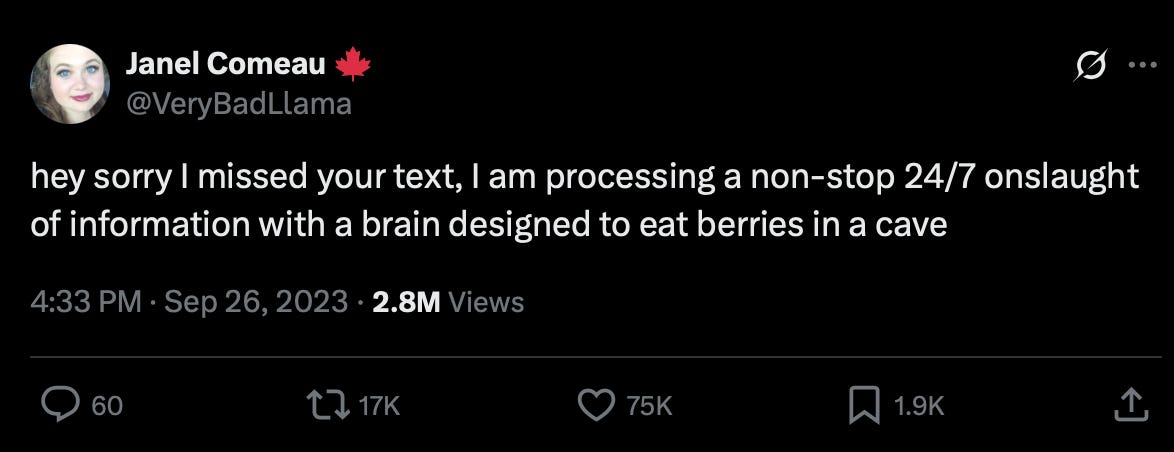
But it’s also true that our brains and nervous systems are not accustomed to handling the influx of information that firehoses at us daily. As one citizen of the internet put it:
Having a choice about how we consume news, how we witness human suffering, is a weighty privilege. It begs thorny questions about apathy and empathy: How much do we ask ourselves to engage with, relate to, and understand what others are going through (especially those who don’t look or live like us), and how often do we allow ourselves to close off, to turn away from human experiences that makes us uncomfortable? And what does that choice say about who we are?
These questions—and the ongoing suffering we are asked to witness, make sense of, and act upon—returned me to two wartime poems I wrote in 2023 and 2024. Both wrestle with the experience of observing war crimes, violence, and ongoing systemic injustice from the safety of screens and the privilege of remove.
I hope they’ll reach some part of you that needs awakening to the menace of apathy, the powers of empathy, our in-born capacity to hope as an act of defiance.
The first, “During the War (after Ilya Kaminsky),” is from 2024.
During the War
after Ilya Kaminsky
I cannot say we lived happily during the war.
We existed.
We raged.
We took sides.
We grew numb.
We, all of us, apologizing.
We scrolled and called representatives,
we protested and donated and vomited,
we compared our children to theirs,
we wept in American luxury, made new words
for horror, despair, enough, we worried
our neighbors might hate us, dreamed that
witnessing together might mean agreement,
ceasefire, absolution, we willed this resolution,
this embargo, this election to be different.
But waking, the sun is the same, the sky unmoved,
the people across oceans are still burning
inside my phone.
I do not know (forgive me) how to end a war.
Read Ilya Kaminsky’s “We Lived Happily During the War” here.
The second poem, “Cream,” I wrote in 2023 and updated last week.
Cream
I used to go to a tiny deli in San Francisco where
a French woman made yogurt with milk so whole it
tasted like fatty green fields, served cups of it
laced with rosewater and blueberries,
I used to eat it like I’d never heard of hypercapitalism
or climate collapse, starving children or genocide,
Alligator Alcatraz or ICE abductions,
I used to scoop the cool cream into my mouth,
taste honey and rose spread a blanket of ignorance
across my tongue, sweet and aromatic,
soothing and complete, I used to bite into the berries,
let them burst in my cheeks, look right
into the sun as I strode down Geary Street,
willfully unseeing the women who knew it in their bones,
who couldn’t make it up off the sidewalk
because of what they’d seen, I used to swallow
that dense white cream and think yes, this must be
all there is, couldn’t this be it, isn’t this it,
isn’t it, isn’t it, isn’t it?
As I was writing this post, former pastor John Pavlovitz published “The White Privilege of Avoiding Bad News”. In it, he observes:
“There are days when I feel my own white comfort creeping in, when I’m tempted to choose blissful ignorance, retreating into the cloistered bubble of imagined, or at best, temporary safety. I know that were I to fully indulge in the buffers my privilege affords me, this could easily lull me into an apathy that is dangerous to my soul, harmful to this nation, and deadly to strangers who find themselves in the path of realities that are far more than uncomfortable headlines.”
Earlier this year, as executive orders roiled communities and neighborhoods, a friend (a straight white American, like me) kept asking me the same question: How is all this affecting you? They saw me going to protests, rallying against the administration’s actions, and often interpreted my fury at the system as something closer to a siloed, individual depression. They wanted me to protect my wellbeing and my sanity. They weren’t mapping the same through-lines of interconnection that I felt in my bones.
When I explained that attending protests in community brought me great joy, they were gladdened. But their question mirrored the shadow of apathy and overwhelm that dwells in many white folks in the United States who take their presumed safety for granted. Who don’t want to know the answer to that question: What do we owe each other?
Instead, that shadow whispers: As a white person holding the privilege of hetero, socioeconomic, and geographic comfort, couldn’t you just look the other way? Might ignorance afford you proverbial bliss?
Certainly, there are days when I don’t want to know.
Of those times, Pavlovitz writes:
“When I find myself overwhelmed or disheartened by the steady stream of horrible news parading in front of me, I try to remember to ask myself, ‘Who is feeling this news more deeply than I am? Where is the burden? Who is suffering?’ That helps me not avert my eyes and prompts me to lean in.”
Crafting a sensible strategy for news consumption is humane and healthy.
And so is widening the aperture of my capacity to relate to others, to insist on hope through action, to build community through discomfort, to find kindness in myself, daily.
As poet
wrote this week:I would rather people
speak up imperfectly
than not speak up at all.
I would rather have people
join movements for liberation late
than not have them join at all.
I would rather
hear your voice
than not hear it at all.
It is not too late to save this world.
And I would rather people believe that
than not believe it at all.
SOME HOT LINKS
To read.
This interview with Dr. Jen Gunter about the Goop-to-MAHA / alt-right pipeline.
“Heartstopper”: This long-form piece (you can listen, too) from
about the abuses of Swami Rama and the Himalaya Institute, and the systems that protect powerful men, is phenomenal.“The Trouble with Wanting Men” transcends anecdotes to offer a psychoacademic lexicon for the challenges of dating cis het men these days. See: “heteropessimism,” “normative male alexithymia” (!), and more.
To listen.
I listened to the audiobook of Taylor Jenkins Reid’s new novel Atmosphere: A Love Story and gosh I loved it: women astronauts, the ‘80s, unconventional family and community systems, feminism, strawberry milkshakes, suspense, outer space!
My friend Emma says we all must listen to this Radio Atlantic episode about the books we read in high school and I can’t wait.
To watch.
The intersectional environmentalist docu-series “Go Gently” with Bonnie Wright and Wyn Wiley (aka Pattie Gonia) is delightful—push through the first episode and you’ll be rewarded.
And of course, after last week’s post about traveling as a single woman, I’m eager to check out the new “Solo Traveling with Tracee Ellis Ross”.
STAY SANE
Thanks for being in community with me. What do you think we owe each other?
Love,
Lily
We owe each other “Yes” when we are called upon to do for another. “No” when we are called upon to do violence in the name of country. As H.G. Wells so prophetically put it in 1913 in The World Set Free “… The little circles of their egotisms have to be opened out until they become arcs in the sweep of the racial purpose. And this that you teach to others you must learn also sedulously yourselves. Philosophy, discovery, art, every sort of skill, every sort of service, love: these are the means of salvation from that narrow loneliness of desire, that brooding preoccupation with self and egotistical relationships, which is hell for the individual, treason to the race, and exile from God....”